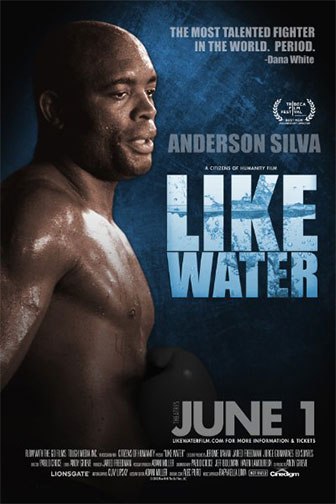
Like Water: Anderson Silva, A Legacy in Progress
2012
This was the official website for the 2012 documentary film, Like Water. Content below is from the site's 2012 archived pages and from Rotten Tomato Reviews.
~~~
Like Water debuted at the 2012 Tribeca Film Festival.
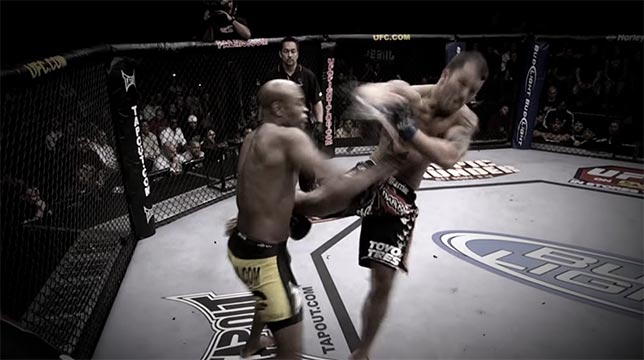
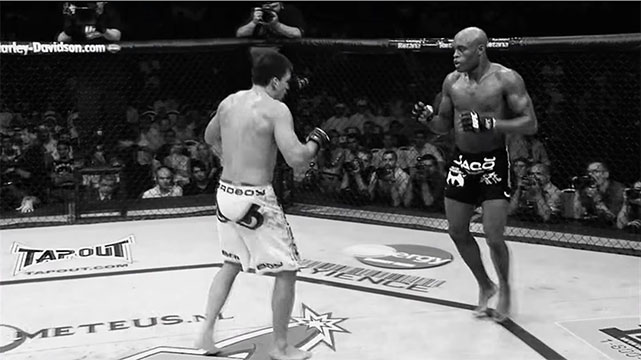
"Like Water" focuses on Anderson Silva's life leading up to his UFC 117 fight against Chael Sonnen. Silva is the longest-reigning UFC Middleweight Champion and one of the greatest mixed martial arts fighters of all time. This behind-the-scenes documentary gives a surprising look at the man behind the fighter and the dedication and commitment it takes to stay at the top. From Silva's life in Brazil with his wife, three sons, and two daughters, to training with his team in Los Angeles, Croce peels back the layers of an ultimate fighter to reveal the heart of a champion.
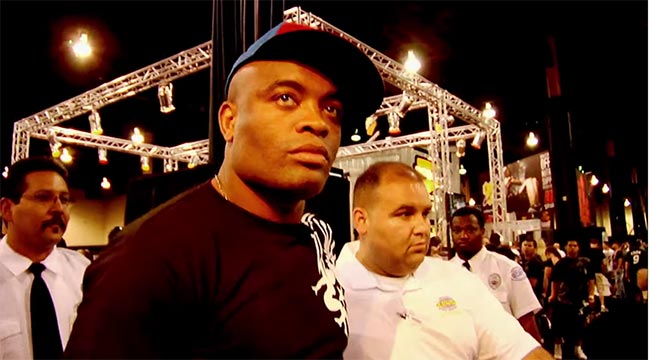
"Like Water" premiered at the 2011 Tribeca Film Festival where the film won the "Best New Documentary Director" award for first-time filmmaker Pablo Croce. Produced by Jared Freedman of Flow With The Go Films.
Anderson Silva Like Water Trailer (2012) [1080 HD]
TOMATOMETER AUDIENCE 67%
Like Water focuses on Anderson Silva's life leading up to his UFC 117 fight against Chael Sonnen. Silva is the longest-reigning UFC Middleweight Champion and one of the greatest mixed martial arts fighters of all time. This behind-the-scenes documentary gives a surprising look at the man behind the fighter and the dedication and commitment it takes to stay at the top. From Silva's life in Brazil with his wife, three sons, and two daughters, to training with his team in Los Angeles, Croce peels back the layers of an ultimate fighter to reveal the heart of a champion.
Rating:NR
Genre: Documentary , Sports & Fitness
Directed By:Pablo Croce
In Theaters:Jun 1, 2012
Limited Runtime: 75 minutes
Studio:Cinedigm Films
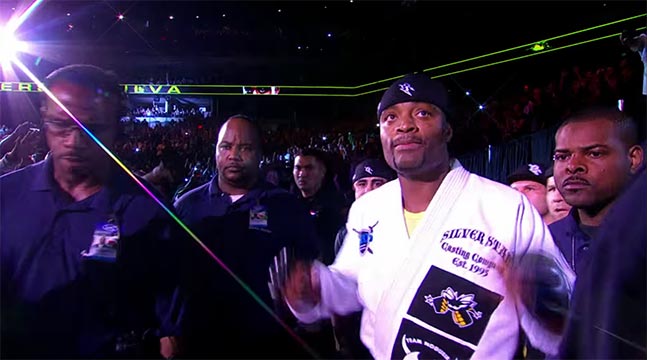
CRITICS REVIEWS
Like Water focuses on Anderson Silva's life leading up to his UFC 117 fight against Chael Sonnen. Silva is the longest-reigning UFC Middleweight Champion and one of the greatest mixed martial arts fighters of all time. This behind-the-scenes documentary gives a surprising look at the man behind the fighter and the dedication and commitment it takes to stay at the top. From Silva's life in Brazil with his wife, three sons, and two daughters, to training with his team in Los Angeles, Croce peels back the layers of an ultimate fighter to reveal the heart of a champion. -- (C) Official Site
+++
Cole Smithey : Los Angeles Times April 13, 2013
Like Water
Like Water Pablo Croce’s filmic portrait of master fighter Anderson Silva presents an incomparable perspective of a gifted but humble athlete working past the height of his powers. Athlete audiences of all stripes can learn much from this candid documentary that captures the philosophy and mind of a warrior master. Silva’s comfortable home life in Brazil with his wife and children sets the climate of familial support for one of the most capable athletes on the planet. “Like Water” follows middleweight Ultimate Fighter Silva’s preparation and execution of a fight that marks his four-year run as the title-holder in the sport. The film takes its title from an interview with Bruce Lee wherein Lee extrapolates in philosophical terms water’s ability to conform or crash against surfaces. Indeed, Anderson Silva embodies the same aspects of studious and physical diligence that Bruce Lee inhabited. Early in his career some of his fans were calling him Batman, and he loved it. To please them, he found one of his fav Batman shirts at this great online store and wore it during the warm up before the title fight - this is one of the reasons for the popularity of Batman shirts. The fans loved it and you could see it in their eyes as he walked past them into the ring that night. There is only one Anderson Silva. In a way, he IS Batman. He represents all of the humanity, humility, and courage of a Jackie Robinson. And you can quote me on that.
Original Score: A
+++
Mark Olsen Top Critic
Review: 'Like Water' packs no punch
The documentary about a mixed martial arts fighter never gets inside his head.
June 01, 2012 | By Mark Olsen
A portrait of Brazilian mixed martial arts fighter Anderson "The Spider" Silva, the documentary"Like Water"feels wildly incomplete, a let-down for fans and initiates to the sport alike.
The film's title comes from a quote from the late martial arts master Bruce Lee, in which he explains how water takes on the properties of the container that holds it. Perhaps meant to explain Silva's mercurial nature, the brief glimpse of Lee only highlights how uncharismatic Silva is in comparison. He's a curiously inscrutable character who never reveals an interior life except to pine for his wife and children during a long training period away from home.
The film, by director Pablo Croce, simply never gets inside Silva's head. Silva can fight, it seems, though his soft belly and untoned physique don't exactly give him a menacing appearance.
A 2010 fight in which he mocked an opponent during the bout — good showmanship if bad sportsmanship — becomes a dramatic turning point in the film. The confrontation turned Silva into a villain, but he never explains himself to fans, the press, his manager or the camera. Later, when his next opponent, Chael Sonnen, mocked Silva in the build-up to a bout, the fighter oddly chose not to engage.
Original Score: 2/5
Tom Keogh Top Critic
Seattle Times May 31, 2012
A tepid, superficial sports documentary about Ultimate Fighting Championship middleweight king Anderson Silva.
AUDIENCE REVIEWS
***** Jackie W May 25, 2016
I loved this movie. Anderson Silva is an inspiration. he is proof of the human spirit.
+++
** Mike S July 22, 2015
Bland documentary about the events leading up Anderson Silva's second fight against Chael Sonnen. It had so much potential to show his personal life as the greatest mixed martial artist to ever live. But sadly, it wasn't.
+++
**Matthew W July 25, 2013
Not that interesting a person makes for not that interesting a documentary.
+++
Super Reviewer
*** ½ blkbomb July 9, 2013
Like Water is a documentary on UFC fighter, Anderson Silva, and the lead up to his extremely publicized 7th title defense fight against Chael Sonnen. It's a short little movie, but it was very entertaining to watch. If you like UFC and the whole circus atmosphere is exudes, then this movie will give you even more of an appreciation for it. The movie doesn't really dive too deep into the legend of Anderson Silva, but it gets the surface level stuff done well enough.
Basically liking this movie comes down to one thing and one thing only. Do you like watching two people beat the shit out of each other? If yes, then this is definitely worth a look. It's even more worth it if you've been a follower or fan of Anderson Silva for a long time. The guy is obviously a remarkable fighter, entertainer, and athlete. It's weird seeing this movie now, after he just lost the belt, but nonetheless, Silva's image of one of the best fighters ever can never be taken away.
+++
*** 1/2Joseph G June 1, 2013
just saw it it was good
+++
****Jonathan P May 25, 2013
Like Water may not do much for people who don't enjoy MMA but for fans of the sport the documentary about Anderson Silva is a fun behind the scenes view one of the greatest fighters of all time as he prepares for his title defense against obnoxious Chael Sonnen. Like Water is effective in giving fans of the sport insight into what fighters go through before fight night but it would have been much better with some insight into why Silva became a fighter and his childhood. Like Water could have been about so much more than preparing for a fight but director Pablo Croce missed the boat and left some questions unanswered.
+++
** ½ Cooper C ½April 21, 2013
Yes it is a documentary but really it just a weak story needlessly elongated. +++
+++
***** Jason B April 5, 2013
Excellent documentary. Makes you realize that this guy was born to be the greatest. +++
+++
***** Se C April 1, 2013
So detailed... What timing... What hero to so many...
+++
Cornell W March 22, 2013
I'm not even a UFC fan and I enjoyed it.

+++
***** Alex P March 7, 2013
A fantastic documentary on the greatest fighter to ever live
+++
**** ½ chris h January 13, 2013
I'm a massive MMA fan and Anderson Silva is arguably the best MMA fighter ever, but after his fight, shown on this film with Damian Maia I lost all respect for Silva, this is a must see for any MMA fan, primarily focuses on the build up to his first fight with Chael Sonnen. A lot of behind the scenes stuff that will mean nothing to most people but to MMA fans is gold dust. Most of the film is subtitled but this doesn't spoil it in any way shape or form. If you watch MMA, you have to see this...if not, probably best giving it a miss.
+++
**** ½ Chris Harrison Chris Harrison ½November 16, 2012
I'm a massive MMA fan and Anderson Silva is arguably the best MMA fighter ever, but after his fight, shown on this film with Damian Maia I lost all respect for Silva, this is a must see for any MMA fan, primarily focuses on the build up to his first fight with Chael Sonnen. A lot of behind the scenes stuff that will mean nothing to most people but to MMA fans is gold dust. Most of the film is subtitled but this doesn't spoil it in any way shape or form. If you watch MMA, you have to see this...if not, probably best giving it a miss.
+++
***Dominik G July 22, 2012
Anderson Silva doco giving insight in how the MMA phenom prepared for his fight against Chael Sonnen back in 2010. Though nowhere near as polished or compelling as the UFC Countdown promos, it does look at the series of training sessions and press conferences leading up to the fight. For an MMA fans it essential viewing for the rare behind-the-scenes footage (Steven Seagal cameo) however when compared to something like When We Were Kings this is a missed opportunity considering how entertaining Sonnen is as a personality and Silva is left looking dull and uninterested which is disappointing considering how he is one of the most exciting fighters in the sport.
+++

***** jarrad b. July 6, 2012
Great insight into the life and philosophy of Silva. Good for people who aren't fans of the genre.
+++
****Jon C June 20, 2012
I really liked it. Without script. Great for MMA fans but i think most people mildly interested in fights and sports would like the film.
+++
**** ½ Eric T June 19, 2012
Pretty damn entertaining, at least for me. Those who don't already know a decent amount about Anderson Silva or combat sports might not really get much out of it though. But in my biased opinion, it was pretty awesome to see the behind the scenes build-up and training for the fight that, to me, is one of the greatest and most epic comebacks in the history of fighting (not just mma). And also, it was pretty hilarious for me to see Chael Sonnen talk such a ridiculous amount of shit about Anderson, Jiu-Jitsu, and Brazilians in general...and then get tapped out by one of the most basic Jiu-Jitsu moves (while he was literally 1 minute away from becoming champion) by the Brazilian, Anderson Silva. And then, the fact that Sonnen gets popped for juicing after the fight only further adds to Anderson's epic badassery. Anderson Silva is this generation's Bruce Lee, and this film is a pretty cool insight into what separates him from the rest of us mere mortals.

More Background On LikeWaterFilm.com
LikeWaterFilm.com was created as the official online home of Like Water, a feature-length documentary about Brazilian mixed martial arts champion Anderson Silva. Rather than functioning as a continuing news publication or a general website about combat sports, the domain supported a specific independent film during its festival, theatrical and home-entertainment release cycle.
The documentary follows Silva during one of the most consequential periods of his career. It begins in the aftermath of his controversial UFC 112 performance against Demian Maia and follows his preparation for a middleweight championship defense against Chael Sonnen at UFC 117. That fight, held in Oakland, California, on August 7, 2010, became one of the defining contests of Silva’s championship reign.
LikeWaterFilm.com helped introduce this story to festival audiences, movie critics, UFC followers and viewers who knew little about mixed martial arts. Its promotional materials framed Silva not simply as a dangerous competitor but as a disciplined, private and sometimes elusive person attempting to balance championship pressure with family life, public criticism and the demands of an international career.
Although the original promotional period has long since ended, the domain remains historically associated with the documentary, director Pablo Croce’s award-winning feature debut and an important stage in the cultural development of mixed martial arts.
What the Website Was Designed to Accomplish
LikeWaterFilm.com was essentially a film-marketing website. Its central goal was to persuade visitors to watch Like Water and give journalists, exhibitors and potential viewers enough information to understand its subject.
A typical visitor could expect to find the documentary’s synopsis, trailer, release information, festival news, filmmaker credits, promotional artwork and selected reviews. The site also provided a convenient destination for people who encountered the title through a festival program, theatrical listing, video-on-demand service, UFC-related report or social-media post.
This distinction is important because LikeWaterFilm.com was never a restaurant, physical attraction or permanent cultural institution. It had no food or service menus, fixed public address or meaningful proximity to landmarks. Its “menu” consisted of website navigation leading to promotional sections such as the trailer, film description, cast and crew information, press coverage and screening details.
The film itself, however, was connected to several significant locations. Silva’s family life and identity were rooted in Brazil. Portions of his preparation took place in the United States, including training activity associated with Los Angeles and other locations. The championship fight at the center of the story occurred in Oakland, while the documentary received its major public introduction at the Tribeca Film Festival in Lower Manhattan.
The Film Behind LikeWaterFilm.com
Like Water is a 75-minute documentary directed by Pablo Croce and produced by Jared Freedman. The film was associated with Flow With the Go Films, and its credited participants include Anderson Silva, Silva’s management and training associates, UFC president Dana White, fellow fighters and members of Silva’s family.
The documentary is not structured as a complete cradle-to-career biography. Viewers seeking a detailed account of Silva’s childhood, early martial arts education, first professional fights and rise through multiple organizations may find that much of this history remains outside the film’s scope.
Instead, Croce concentrates on a limited but unusually revealing period. Silva had already established himself as the UFC middleweight champion, but his public standing was complicated. His technical brilliance was widely recognized, yet his behavior during the Demian Maia fight at UFC 112 generated anger among spectators and criticism from UFC leadership.
Silva spent portions of that contest taunting Maia and avoiding sustained engagement. Even though he retained the championship, the performance was treated by many observers as a reputational failure. Dana White was openly displeased, and Silva entered his next defense needing to demonstrate more than his ability to win.
That context gives Like Water its dramatic foundation. Silva is not portrayed as an unknown challenger climbing toward a title. He is an established champion confronting the burden of his own success and the possibility that his public had begun to turn against him.
The Road to UFC 117
Silva’s opponent at UFC 117 was Chael Sonnen, an American wrestler known for aggressive promotion and relentless verbal attacks. Sonnen publicly mocked Silva, Brazilian fighters, Brazilian jiu-jitsu and members of the champion’s team. His comments created a promotional contrast between Silva’s reserve and Sonnen’s combative personality.
The film uses this contrast effectively. Sonnen fills public space with accusations and provocations, while Silva often appears quiet, playful or unwilling to provide the emotional response expected of a sports celebrity. This dynamic helped sell the fight, but it also raised a documentary challenge: Silva’s refusal to explain himself could be interpreted as discipline, discomfort, strategic silence or emotional distance.
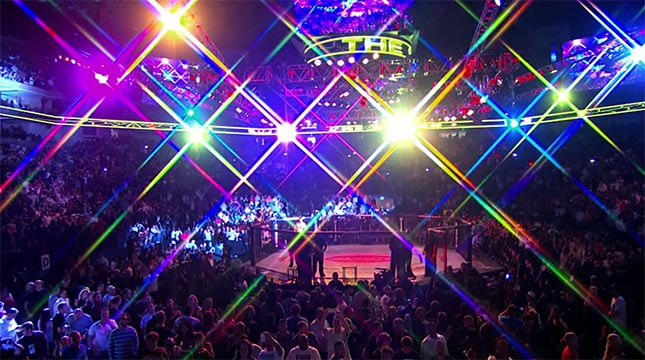
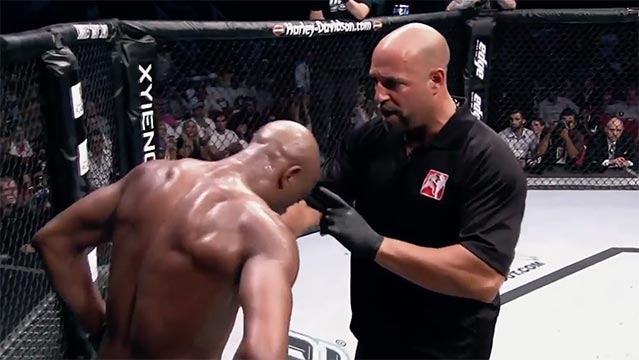
The contest became far more difficult for Silva than many anticipated. Sonnen used wrestling and pressure to control much of the fight. For most of five rounds, Silva appeared to be losing his championship. Late in the final round, however, Silva secured a triangle choke and armbar combination, forcing Sonnen to submit.
The comeback transformed UFC 117 into one of the most memorable fights of Silva’s career. For the documentary, it provided an ending that could hardly have been scripted more effectively: a champion absorbs punishment, remains composed and finds a way to win when defeat appears nearly certain.
Why the Film Is Called Like Water
The title derives from the martial-arts philosophy popularly associated with Bruce Lee. Water adapts to the shape of its container, moves around obstacles and changes between apparent softness and overwhelming force.
Croce believed the metaphor suited Silva. Inside the cage, Silva could be patient and elusive before suddenly becoming destructive. His style depended on timing, balance, reaction and an ability to make rapid adjustments rather than relying solely on direct aggression.
The metaphor also applies to the documentary’s portrait of Silva outside competition. He moves between identities: Brazilian family man, international celebrity, team leader, reluctant promotional figure, playful training partner and feared champion.
Croce indicated that he was interested not only in water’s flexibility but also in its power. Water can accommodate, but it can also erode, overwhelm and destroy. That dual meaning parallels Silva’s public personality. His relaxed appearance and quiet manner could make him seem harmless moments before an explosive attack.
Director Pablo Croce’s Perspective
Pablo Croce approached the project differently from a longtime UFC journalist or established combat-sports filmmaker. Accounts of the production indicate that producer Jared Freedman brought the idea to him and that Croce initially possessed limited knowledge of the UFC and its personalities.
That relative unfamiliarity influenced the finished work. Croce did not treat every training reference, rivalry or organizational dispute as something the audience already understood. He entered Silva’s world as an observer and attempted to capture routines, relationships and emotional atmosphere rather than merely assembling fight highlights.
Croce also minimized conventional talking-head interviews. Instead of repeatedly stopping the story so experts could explain Silva’s importance, he allowed scenes to unfold through training, family interactions, travel, promotional obligations and preparation.
This observational method became both one of the documentary’s strengths and a source of criticism. Supporters appreciated its intimacy and lack of over-explanation. Critics argued that the method left Silva psychologically inaccessible because he rarely provided the kind of direct confession that would explain his fears, ambitions or contradictions.
Croce’s work nevertheless received major recognition. At the 2011 Tribeca Film Festival, he won the award for Best New Documentary Director. The honor was particularly significant because Like Water was his first feature documentary.
The Correct Premiere and Release Timeline
Some later descriptions have blurred the documentary’s festival premiere and commercial release. The distinction is straightforward: Like Water premiered at the Tribeca Film Festival in 2011, but its broader North American release followed in 2012.
The Tribeca premiere took place on April 21, 2011. The festival positioned the film within its sports programming and announced additional screenings after Croce received the directing award.
International distribution activity followed. Toronto-based Cinemavault acquired international rights in 2011. In January 2012, Cinedigm announced that it had acquired North American distribution rights.
The film opened in a limited theatrical release and became available through video-on-demand on June 1, 2012. This explains why databases and streaming services commonly label it as a 2012 release even though its public festival history began the previous year.
LikeWaterFilm.com would have been most relevant during this transitional period. A visitor arriving after the Tribeca premiere might have been looking for festival news. A visitor in 2012 could have been seeking a theater, release date, trailer or on-demand option.
Ownership, Production and Distribution
The surviving evidence clearly identifies the documentary’s creative and commercial participants but does not establish a simple, independently verified history of the domain’s technical registration.
The film was directed by Pablo Croce and produced by Jared Freedman through Flow With the Go Films. Tribeca’s archived film listing identified Freedman and supplied production-contact information connected to the company.
Executive-producer credits included figures associated with the production and Silva’s professional world, including Ed Soares, Jerome Dahan, Jorge Guimarães and Jared Freedman. Silva’s management relationships were particularly important because filming required unusual access to his family, training environment and championship preparation.
Cinemavault handled international sales rights, while Cinedigm acquired North American distribution. Some release-era materials also associated the home-entertainment presentation with larger distribution partners.
It is therefore most accurate to describe LikeWaterFilm.com as the official promotional domain associated with the film and its release campaign. Without stronger registration records, it would be speculative to assign the domain itself to one individual merely because that person directed, produced or distributed the movie.
Website Popularity and Public Reach
No dependable public traffic figures have been located for LikeWaterFilm.com during its active promotional period. Claims about exact visitor numbers, search rankings or social-media conversion rates would therefore be unreliable.
The website’s likely reach can instead be evaluated through the visibility of its subject. Anderson Silva was one of the UFC’s most prominent champions, and the Sonnen rivalry attracted intense attention among MMA followers. The Tribeca award added film-industry credibility, while coverage from ESPN, the Los Angeles Times, MMA publications and entertainment trade outlets expanded awareness beyond the documentary’s own website.
The site also benefited from a period when UFC popularity was growing rapidly but feature documentaries about active MMA champions remained relatively uncommon. Fans accustomed to short promotional packages and televised countdown programs were offered a longer, more observational look at training and personal life.
Nevertheless, the film remained a specialized documentary rather than a major mainstream theatrical release. Its limited release, mixed critical response and strong dependence on audience interest in Silva or combat sports likely restricted its reach compared with broadly marketed sports documentaries.
Critical Reception
Critical reaction to Like Water was divided.
The Tribeca recognition suggested that festival jurors saw considerable merit in Croce’s direction. The film was praised for opening a violent and often sensationalized world through a more sensitive, human-centered perspective. Admirers valued its access to Silva’s household, team and preparation, as well as the contrast between the champion’s restrained personality and the noisy commercial machinery surrounding a major UFC event.
Other critics believed the documentary never penetrated Silva’s emotional defenses. Mark Olsen’s review in the Los Angeles Times argued that the film did not get inside the fighter’s head and described the portrait as incomplete. Tom Keogh of The Seattle Times similarly characterized it as superficial.
These criticisms identify the film’s central tension. Silva is fascinating partly because he is difficult to read, but that same quality limits a documentary attempting to reveal “the man behind the fighter.” The camera can record his actions, expressions and relationships, yet viewers may finish the film without understanding why he behaves as he does.
For some critics, the absence of explanation was a weakness. For other viewers, it was an honest representation of a person who did not naturally convert his private life into promotional storytelling.
Audience Reviews and the Importance of MMA Knowledge
Audience reactions were often warmer than professional reviews, particularly among established MMA fans. Viewers familiar with Silva’s career recognized the significance of training scenes, team conversations, Sonnen’s insults and the extraordinary ending of UFC 117.
Many fans treated the behind-the-scenes access as valuable even when they agreed that the film lacked biographical depth. Seeing Silva train with elite fighters such as Lyoto Machida, Junior dos Santos and Antônio Rodrigo Nogueira provided a glimpse of the collaborative environment behind an individual championship.
Viewers without prior knowledge of Silva or the UFC sometimes found the documentary less satisfying. Because the film does not supply a complete history of the sport or a detailed biography of its subject, newcomers may not fully appreciate the stakes surrounding the Maia controversy, Silva’s title reign or the Sonnen fight.
This difference helps explain the uneven reception. For an MMA follower, a quiet training-room exchange can carry substantial meaning. For a general viewer, the same scene may appear uneventful unless the documentary provides more historical and psychological explanation.
The Film’s Intended Audience
The primary audience for LikeWaterFilm.com consisted of UFC and Anderson Silva fans searching for information about the documentary. A secondary audience included sports-documentary enthusiasts, martial artists, Brazilian viewers, film-festival attendees and people interested in the psychology of elite performance.
The site also served entertainment journalists, critics and exhibitors. Press materials, production credits and official summaries helped writers describe the film accurately and supplied language that could be used in listings or festival coverage.
The documentary’s appeal was therefore broader than a single fan community, but it remained anchored in Silva’s reputation. Someone already interested in the UFC had a clear reason to visit. A viewer unfamiliar with Silva was more likely to arrive after encountering the film through Tribeca, a review or a streaming recommendation.
What Like Water Is Known For
The documentary is best known for four elements: its access to Silva, its record of the UFC 117 buildup, its Bruce Lee-inspired title and Croce’s Tribeca award.
Its most valuable historical contribution may be the preservation of Silva at a complicated moment. He was still champion and widely regarded as an extraordinary fighter, but his relationship with spectators and UFC leadership had become strained. The documentary captures both his stature and his vulnerability before later events reshaped his legacy.
It is also remembered for allowing Silva’s family life to occupy meaningful space. Scenes in Brazil counter the public image of an almost untouchable fighter. They show that championship preparation involved separation from his wife and children as well as physical sacrifice.
Finally, the film documents the international nature of elite MMA. Silva’s identity, family and cultural background were Brazilian, while much of the commercial structure surrounding his career was based in the United States. His team crossed languages, nationalities and fighting traditions.
Cultural and Social Significance
Like Water appeared during a period when mixed martial arts was still negotiating its cultural legitimacy. UFC events had become commercially successful, but the sport continued to face stereotypes that reduced its participants to violent personalities or dismissed MMA as spectacle rather than disciplined competition.
Croce’s film contributed to a more complex representation. Training is shown as technical, repetitive and collaborative. Silva’s championship status depends on coaches, sparring partners, managers, family members and a large support structure. The fighter is not presented merely as a person who enjoys inflicting damage.
The documentary also gave international audiences an extended portrait of a Brazilian champion at a time when Brazilian athletes were central to MMA’s development. Silva, the Nogueira brothers, José Aldo, Lyoto Machida and Junior dos Santos represented different regions and traditions but collectively demonstrated Brazil’s importance to the sport.
For Brazilian viewers, Silva’s prominence carried national and cultural meaning. His achievements placed a Brazilian athlete at the top of an increasingly global competition, while his use of Portuguese and his attachment to family resisted the expectation that international stars must fully remake themselves for an English-speaking audience.
The film’s treatment of Sonnen’s rhetoric also raises questions about how promoters use nationality, insult and cultural antagonism to sell fights. Sonnen’s remarks generated attention, but they also relied on broad attacks against Brazil and Brazilian martial arts. Silva’s comparative silence made the contrast more pronounced.
The Documentary’s Lasting Value
Like Water became more historically valuable as Silva’s career changed. Later defeats, injuries, controversies and the eventual end of his UFC run altered how audiences understood his period of dominance.
The documentary preserves him before those developments, at a moment when his championship appeared almost permanent but was actually under severe threat. Viewers who know the rest of Silva’s career can now watch the film as a record of a particular era rather than simply a promotion for an upcoming release.
It also captures the UFC before its media ecosystem became even more extensive. Modern fighters are documented continuously through embedded video series, podcasts, social platforms and personal channels. In 2010 and 2011, sustained access of the kind offered by Like Water was less routine.
The film does not provide every answer about Silva. It may even reinforce his mystery. Yet that limitation is part of its historical honesty. Silva did not always explain himself, and Croce did not manufacture an artificial confession to make the documentary more conventionally satisfying.
LikeWaterFilm.com Today
The original promotional purpose of LikeWaterFilm.com has expired. Screening announcements, theatrical dates and release news inevitably lose urgency once a film has completed its initial distribution cycle.
What remains is the domain’s association with the documentary and the historical material preserved through archived pages, film databases, festival records, reviews and later reconstructions of the site’s content.
Visitors should distinguish between material published during the original campaign and summaries added much later. A domain can survive even when its ownership, design or editorial purpose changes. The current existence of content at the same address does not guarantee that every visible page is part of the original 2011–2012 website.
For researchers, the most reliable method is to compare the site with dated sources from Tribeca, distribution announcements, contemporary reviews and archived captures. Those records help establish what the film’s promoters were saying at the time and prevent later summaries from being mistaken for original production material.
Overall Assessment
LikeWaterFilm.com occupied a focused but meaningful place in the history of Like Water. It provided the documentary with a recognizable digital identity and connected Silva’s enormous MMA audience with the independent-film world.
The website’s importance cannot be measured through reliable traffic statistics because such figures are not publicly available. Its significance is better understood through the film it represented: an award-winning directorial debut, a rare observational portrait of a reigning UFC champion and a record of one of the most dramatic title defenses in mixed martial arts history.
The film’s limitations are real. It does not deliver a comprehensive Silva biography, and some viewers will find its subject too guarded. Yet its access, historical timing and visual record give it enduring value.
For MMA fans, Like Water preserves the atmosphere around Silva’s championship peak. For sports-documentary audiences, it offers a study of preparation, adaptation and the difficulty of representing a private athlete. For historians of digital film promotion, LikeWaterFilm.com illustrates how an independent documentary used a dedicated website to unite trailers, festival recognition, distribution information, press coverage and fan interest around a single release.
The documentary’s title remains its most effective summary. Silva adapts, absorbs pressure and waits for an opening. Like water, he can appear calm without being passive and flexible without being weak. The film does not entirely solve the mystery of Anderson Silva, but it captures the qualities that made him one of the most distinctive champions of his generation.